Implementation record of SPLYZA Motion :
Kurashiki Heisei Hospital

Mr. Ryo Yamazaki, Physical Therapist, Kurashiki Heisei Hospital
Kurashiki Heisei Hospital provides comprehensive rehabilitation medical care, from the acute phase to the
recovery phase and home care, in Kurashiki City, Okayama Prefecture. The hospital has introduced the
markerless 3D motion analysis app "SPLYZA Motion" to objectively evaluate the effects of rehabilitation,
utilize it for feedback to patients, facilitate discussions among staff, and further apply it to clinical
research.
In this interview, we spoke in detail with Mr. Ryo Yamazaki, a physical therapist in the Rehabilitation
Department, about the background of its introduction, specific use cases, and the effects after
implementation.
(The interview was conducted online on October 24, 2025.)
■ Challenges Before Introducing SPLYZA Motion
▶︎The Need to Record "Rehabilitation Effects" Objectively and Quantitatively
Originally, the catalyst was a policy set by my supervisor stating that "we need to record the effects of
rehabilitation and treatment objectively and quantitatively," which led us to start considering the
introduction of a tool for that purpose.
In the daily clinical setting, there are inevitably many aspects that rely on the "observational evaluation"
of physical therapists. While that is of course important, we had a desire to supplement it with objective
data and, furthermore, accumulate that data to connect it to future clinical research.
Fortunately, I was already using SPLYZA Motion in advance while involved in joint research with Kibi
International University, so I somewhat understood its features. Also, since my supervisor knew about
the
app, the suggestion came up: "How about that one?
■ Decisive Factors for Introducing SPLYZA Motion
▶︎Overwhelming "Ease of Measurement": Handiness and Accuracy Usable in Clinical
Settings
The deciding factor for its introduction was the overwhelming "ease of measurement."
Conventional marker-based motion capture facilities are, of course, not available at our hospital, and
institutions that have them are quite rare. Even if we had one, considering the time required for
measurement and various other factors, I felt it would be quite difficult to realistically continue
acquiring data in a clinical setting.
What we were looking for was the ability to "easily capture motion with a certain degree of accuracy." We
judged that SPLYZA Motion makes this possible and decided to introduce it.
■ Actual Utilization Methods / Use Cases of SPLYZA Motion
▶︎Widely Utilized from Orthosis Selection to Pre/Post-Surgery Comparison and Caregiving
Areas
Currently, we are utilizing it in a very wide range of situations.
1. Selection and Adjustment of
Orthotics
When selecting orthotics for patients with lower limb paralysis, we use it to determine how fine condition
adjustments (e.g., adjusting shoe height) affect their movement. Because we can meticulously check minute
joint movements and postural changes, it is useful for finding better conditions for that individual.
2. Comparison of Movements Before and After
Surgery
We evaluate how movements change before and after treatment in surgical procedures such as Deep Brain
Stimulation (DBS) for Parkinson's disease, which our hospital focuses on, and artificial joint surgeries.
3. Feedback in the Caregiving Area (Day
Rehabilitation, etc.)
Even in the caregiving field, we use it to "visualize" changes in users' posture and motor functions. For
example, we utilize it in day rehabilitation to provide clear feedback to the users themselves and their
families on things like "how their standing posture has changed compared to when they came last week."
4. Combined Use with Surface
Electromyography
We sometimes use SPLYZA Motion in combination with surface electromyography, which measures muscle activity.
We use it to analyze the relationship between both aspects—movement (kinematics) and muscle activity—in
order to examine better rehabilitation approaches.
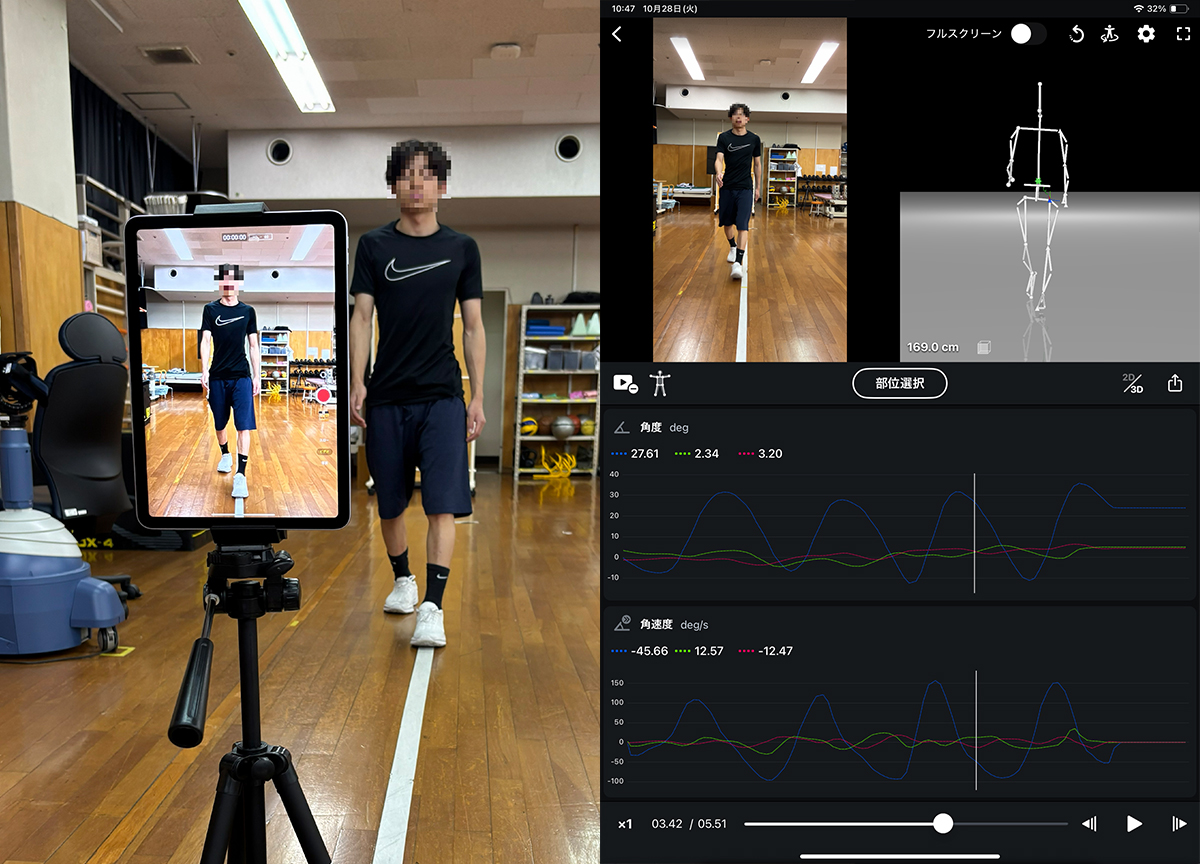
(←)Shooting scene / (→)Screenshot of the app screen
■ Effects After Introducing SPLYZA Motion
▶︎Objective Data Deepens Discussions Among Staff and Patients' Realization
There are three major positive effects after the introduction.
1. Detailed Analysis Using 2-Screen
Comparison
The feature we utilize most is the 2-screen comparison function. Because we can analyze movements before and
after treatment or under different conditions side-by-side with synchronized timing, changes in small joint
movements have become very easy to understand. With this, I feel that evaluating treatment effects and
making finer adjustments and considerations for orthotics based on objective data have become much easier.
2. Data-Based Discussions Among
Staff
Discussions that previously tended to rely on observational results like "it somewhat improved" can now be
held based on data, discussing "which approach is better for this patient." Being able to objectively share
the patient's condition is a major step forward.
3. Providing the Patients Themselves with a
"Realization"
Because we can show the analysis results on a tablet right on the spot, we can communicate to patients,
viewing the screen together, "This area has improved compared to before." Many patients find it difficult to
realize changes themselves, but comparing actual videos and data clarifies the difference, which helps them
realize the effects and feel glad that they received the treatment.
Also, as a unique advantage in a clinical setting, the function that allows us to select the analysis target
is extremely helpful. Our hospital does not have a dedicated measurement space, and due to the effects of
diseases, many patients stand or walk in a precarious state, requiring staff to stay close by for safety.
Even when staff are captured in the frame nearby, this function to select and analyze only the patient is
useful in balancing safety and evaluation.
■ Future Prospects for Use
▶︎Expectations for Further Features and Promoting Utilization within the Hospital
In terms of features, I feel it would be even more helpful if 2-screen comparisons become available in 3D
analysis mode in the future. Since information from the side is particularly important in gait evaluation,
we are looking forward to a 3D comparison display.
Also, I think it would be easier to give back to patients if there were a simple "report function" that
allows us to hand over a summary list of the analysis results.
As for internal challenges, there are still many staff members at the stage of "I heard something like that
exists," so going forward, we plan to gradually increase the number of staff who can use SPLYZA Motion
through training sessions and other means.
*The features of SPLYZA Motion introduced in this article are as of October 2025. The specifications may
differ from the latest version of the app.